
When you’re preparing to sell your home, one of the first questions that comes up is: what’s actually worth spending money on? Home staging is one of the expenses sellers think about most. And it’s a fair question — staging is an investment, and the real estate market doesn’t come with guarantees.
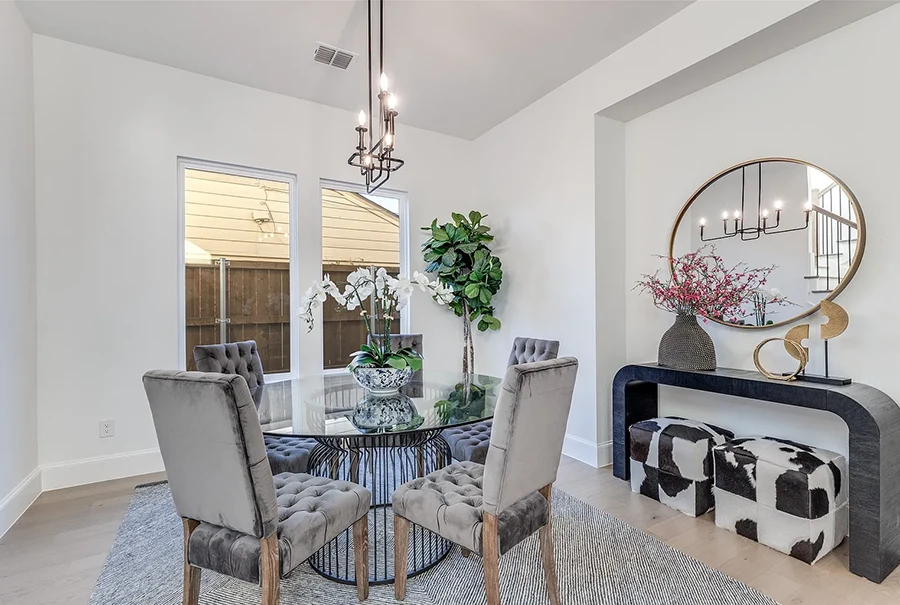
Let’s look at what the data shows. The home staging data available from the National Association of Realtors (NAR) and the Real Estate Staging Association (RESA) gives us some of the clearest industry-level information on this topic, including home staging benefits for sellers across different price points and market conditions. This guide breaks down the key numbers, explains how ROI is calculated in this context, and walks sellers in competitive markets like Dallas–Fort Worth through what they should realistically consider.
Keep in mind: staging doesn’t guarantee a higher sale price. Results depend on the market, the home, the price point, and how the staging is executed. But the evidence is consistent enough that it’s worth understanding before you list.
Home Staging ROI at a Glance
Here are some of the most-cited data points from major industry sources. We’ve noted the source of each figure so you can evaluate it in context.
- 83% of buyers’ agents said staging made it easier for buyers to picture themselves living in the home, according to NAR’s 2025 Profile of Home Staging.
- 29% of sellers’ agents reported that staging increased the dollar value offered by 1%-10%, per the same NAR report — with 19% seeing a 1%–5% increase and 10% seeing a 6%–10% increase.
- 49% of sellers’ agents said staging reduced the time a home spent on the market.
- RESA’s industry data has reported that staged homes have sold for more than list price, with some projects showing sale-to-list ratios above 100% — though these figures reflect association-reported data from member stagers and should be understood as directional rather than universal.
- Vacant homes analyzed by Redfin sold for an average of $11,306 less and spent six more days on the market than comparable occupied homes — a finding that adds important context for sellers of empty properties.
- Staging costs vary widely by market, property size, and scope. Still, Bankrate and HomeLight estimate typical professional staging investments range from $1,500 to $5,000 for many properties, with larger or luxury homes running higher.
These figures come from different types of sources — agent surveys, association-reported project data, and brokerage market analysis. They shouldn’t be treated as directly comparable, but together they paint a consistent picture.


What Is Home Staging ROI?
Return on investment (ROI) is a way to measure what you get back relative to what you put in. Understanding home staging return on investment means looking beyond the sale price — in home staging, most sellers focus only on whether staging will raise the final sale price, but that’s only part of the equation.
True staging ROI can include two separate financial benefits:
- An increase in what buyers offer — the sale price lift
- Savings from selling faster — every additional month a home sits on the market means more out-of-pocket costs for the owner.
When you add both of those together and subtract the staging cost, you get a more complete picture of what staging may have been worth.
A Simple Formula for Estimating Staging ROI
ROI = ((Estimated sale price increase + Carrying-cost savings) − Staging cost) ÷ Staging cost × 100
For example, if staging costs $3,000 and you believe it contributed to a $6,000 higher offer and helped you avoid one month of $2,500 in carrying costs, the estimated return would be ($6,000 + $2,500 − $3,000) ÷ $3,000 × 100 = 183%.
That said, it’s important to be honest about the assumptions involved. You rarely know with certainty what a home would have sold for without staging. Use this formula as a thinking tool, not a prediction.
Does Home Staging Increase Sale Price?
This is the question most sellers ask first, and the data suggests the answer is: it can — but staging does not provide an iron-clad guarantee of a higher sale price.
According to NAR’s 2025 Profile of Home Staging, 29% of sellers’ agents reported that staging increased the dollar value of offers by 1% to 10%. On a $400,000 home, a 1% bump equals $4,000. A 5% bump would be $20,000. Those are meaningful numbers relative to what staging typically costs.
RESA’s published statistics have similarly shown that staged homes often sell at or above list price when staging was part of the listing strategy. HomeLight, a platform that compiles data from thousands of agents, has reported that top agents consistently credit staging as a factor in stronger buyer response.
Why might staging influence what buyers are willing to pay? A few reasons:
- Buyers make emotional decisions. Staged rooms feel warmer, more livable, and easier to picture as home.
- Staging improves listing photography, which is how most buyers first encounter a property online.
- Well-staged homes tend to generate more showings, which can create competitive interest.
- Furniture and décor help buyers understand the scale and purpose of each room.
But results depend heavily on execution, local market conditions, how the home is priced, and the property itself. Staging a home that’s overpriced or in poor condition won’t fix those underlying issues.


Can Home Staging Help a Home Sell Faster?
Time on market matters more than many sellers realize — and this is where staging ROI can quietly add up.
According to NAR’s report, nearly half of sellers’ agents (49%) said that staging reduced the time a home spent on the market. RESA’s data also shows shorter average days on market for staged homes than for non-staged homes in their reported project data.
A Redfin analysis found that vacant homes not only sold for an average of $11,306 less but also spent six more days on the market than comparable occupied homes. That’s significant for anyone selling an empty property.
Every extra month a home sits unsold comes with a bill. Here’s what sellers are typically still paying while they wait:
- Mortgage payments
- Property taxes
- Homeowners insurance
- HOA dues (if applicable)
- Utilities
- Maintenance and repair
- Ongoing lawn care and upkeep
On a home with a $2,200/month mortgage and $300 in other monthly expenses, two extra months on the market costs $5,000 — before any price reduction. If staging costs $3,000 and helps the home sell in that time window, the math can work in the seller’s favor even without any price improvement.


How Much Does Home Staging Cost?
Staging costs vary widely based on where you are, the size of the home, how much of it you’re staging, and whether the home is vacant or occupied.
Here’s how the general categories break down:
- Vacant staging — furniture, accessories, art, and décor are brought in to fill the entire space. This tends to be the most comprehensive and most costly option, but it’s also often where the impact is greatest.
- Occupied staging — a stager works with what’s already in the home, editing, rearranging, and supplementing with select pieces. This is typically less expensive. It’s worth noting that many professional stagers do not offer occupied staging as part of their services, so availability varies.
- Partial staging — only key rooms (like the living room and primary bedroom) are fully staged. This can be a cost-effective middle ground.
Bankrate and HomeLight both estimate that professional staging costs typically range from around $1,500 to $5,000 for a standard scope, with larger homes or more complete staging projects running higher. Initial consultations may be offered separately from full-service staging.It’s worth noting that professional staging involves more than renting furniture. A full-service stager handles design selection, delivery logistics, setup, and removal — services that add real value to sellers who don’t want to manage that process themselves. For sellers in the DFW area, Charter Home Staging offers full-service staging for vacant properties that takes care of every step, from furniture curation to installation and breakdown.
How to Estimate Home Staging ROI
Numbers only mean something when they’re applied to a real situation. Many sellers search for a home staging calculator to get a quick sense of what staging might return — the scenarios below serve that purpose. These are three illustrative examples based on published data ranges and common carrying-cost considerations. These are not predictions or guarantees — they’re meant to show how the formula works across different scenarios.
Scenario 1: Conservative — $350,000 Home
Staging cost: $2,200 (partial vacant staging)
Estimated sale price lift: 1% = $3,500
Carrying-cost savings: $0 (home sells in a similar timeframe)
Estimated ROI: ($3,500 − $2,200) ÷ $2,200 × 100 = ~59%
This scenario assumes a modest price impact with no improvement in time-on-market. Even at the low end of what NAR data suggests is possible, the return exceeds the cost.
Scenario 2: Moderate — $500,000 Home
Staging cost: $3,500 (full vacant staging)
Estimated sale price lift: 2% = $10,000
Carrying-cost savings: $2,800 (one month avoided at $2,800/mo total carrying costs)
Estimated ROI: ($10,000 + $2,800 − $3,500) ÷ $3,500 × 100 = ~266%
This scenario combines a moderate price improvement with time savings. The combined effect of both levers can make the ROI look very strong relative to the investment.
Scenario 3: Stronger Performance — $750,000 Vacant Home
Staging cost: $5,500 (full-service vacant staging, larger property)
Estimated sale price lift: 2% = $15,000
Carrying-cost savings: $6,000 (two months avoided at $3,000/mo total carrying costs)
Estimated ROI: ($15,000 + $6,000 − $5,500) ÷ $5,500 × 100 = ~282%
Higher-priced vacant homes often benefit most from staging because the gap between a well-presented and a poorly presented listing is more visible to buyers. Redfin’s analysis of vacant home performance supports staging in this situation.
All three scenarios are illustrative examples grounded in published data ranges. Actual outcomes will vary.
Vacant vs. Occupied Homes: Where Staging Often Has the Biggest Impact
Not all homes need the same level of staging attention — but vacant homes consistently show up in the data as the situation where staging tends to matter most. Vacant home staging ROI is often stronger than occupied home staging ROI because the gap between a staged and unstaged presentation is far more visible in an empty property.
When a home is empty, buyers often struggle to understand the scale of rooms, picture how furniture would fit, or feel emotionally connected to the space. Empty rooms can feel smaller than they are. They can also feel cold, clinical, or hard to interpret. Without reference points, buyers sometimes focus on flaws rather than potential.
A Redfin analysis found that vacant homes sold for less and took longer to sell than comparable non-vacant listings — a finding cited by the real estate industry. NAR data supports this picture, showing that agents consistently identify staging as especially impactful in vacant properties.
HomeLight research has also shown that top-performing agents consider staging one of their most reliable tools for vacant properties, particularly in markets where buyers have many options.
Occupied homes can benefit from staging too — particularly through editing (removing excess furniture and personal items), refreshing key spaces, and adding coordinated accessories that photograph well. But the ROI case for occupied staging is more variable, as it depends heavily on the home’s current condition.For vacant homes, furniture rental is often the backbone of a staging project. Charter works with professionally coordinated furniture selected specifically for buyer appeal, with delivery to the DFW area typically completed within 3–5 business days.
Which Rooms Matter Most for Home Staging ROI?
If you can’t stage every room, or if you’re looking to maximize impact relative to cost, it helps to know which rooms buyers pay the most attention to.
According to NAR’s 2025 Profile of Home Staging, the rooms that buyers’ agents most commonly identified as important to stage include:
- Living room — consistently ranked as the most important room to stage. It’s where buyers spend the most time during a showing and where lifestyle visualization happens.
- Primary bedroom — closely behind the living room. A well-staged primary suite signals comfort and quality to buyers.
- Kitchen — even when full kitchen staging isn’t involved, cleaning and styling the countertops can have a measurable impact.
- Dining room — important for buyers with families or those who entertain. A properly furnished dining space helps justify the room’s purpose and square footage.
HomeLight’s agent data similarly highlights living rooms and primary bedrooms as the spaces where staging investment tends to produce the strongest buyer response.
Entry spaces, guest rooms, and outdoor areas can also contribute to the overall impression, but these are typically secondary priorities unless they’re a prominent selling feature of the home.
Thinking strategically about which rooms to focus on can help sellers manage staging costs while still capturing most of the potential benefit.
What the Data Does and Doesn’t Prove
We want to be straightforward about something: the home staging statistics cited across the industry are compelling, but they have real limitations worth understanding — especially if you’re considering citing them or making financial decisions based on them.
Here’s what the strongest sources actually show:
- NAR data is based on agent surveys — it reflects what real estate professionals report observing, not controlled experiments. The 2025 report surveyed both sellers’ agents and buyers’ agents, making it one of the more methodologically grounded sources available, but it’s still self-reported opinion data.
- RESA data reflects outcomes reported by member professional stagers. This means it likely skews toward cases where staging was done well, by professionals, and in markets where staging is common.
- Redfin’s analysis of vacant homes is observational data. It shows a correlation between vacancy and lower sales outcomes — but correlation isn’t the same as causation, and other factors may be at play.
- High ROI claims that occasionally circulate — some claiming 300%, 500%, or higher returns — are often based on cherry-picked or poorly sourced data. We present figures grounded in named, reputable sources.
Staging works best when it’s part of a complete selling strategy: accurate pricing, strong listing photography, a well-maintained property, and a thoughtful marketing approach. Staging alone isn’t a fix for a home that’s overpriced or has deferred maintenance issues that buyers will notice during a showing.
The strongest case for staging is not that it guarantees a return — it’s that it consistently appears in the data as a factor that improves buyer perception, reduces time on market, and supports stronger offers when the other conditions are right.
What This Means for Sellers in Dallas–Fort Worth
The national data gives us a useful baseline, but local conditions matter too. In a market like Dallas–Fort Worth — which is large, competitive, and active across a wide range of price points — presentation quality has real consequences for how quickly a listing moves and at what price.
DFW is a market where buyers often shop online before setting foot in a home. That means home listing photos carry significant weight, and staging directly affects how well a home photographs. A vacant room may look underwhelming in photos. A well-staged space tells a story that buyers respond to before they even schedule a showing.
Redfin’s analysis of vacant homes aligns with what real estate professionals in the DFW market observe: vacant homes can be harder to reach and may attract lower initial offers. NAR data similarly points to stronger outcomes in staged properties across varying market conditions.For sellers preparing to list in the DFW area, Charter Home Staging offers full-service staging of vacant homes with professionally coordinated furniture, fast delivery within 3–5 business days, and 60-day staging contracts with month-to-month extensions. Charter handles the entire process end to end — design, delivery, setup, and removal. You can also visit our home staging statistics page for more data on staging outcomes.


Is Home Staging Worth It?
Based on the available data, staging appears worth considering in most selling situations — and strongly worth considering in specific ones.
Staging is most likely to deliver a meaningful return when:
- The home is vacant — empty homes consistently underperform in the data, and the cost of staging is often smaller than the cost of a longer time on market or a reduced offer.
- The home is in a competitive market segment where buyers have other options and presentation influences which listings get more attention.
- The property has layout challenges — odd room shapes, awkward flow, or unusual features that buyers might have trouble interpreting without furniture to anchor the space.
- The seller is motivated to sell quickly, making the carrying-cost savings part of the equation as meaningful as the price lift.
- The home is in a higher price range where a 1%–2% sale price improvement represents a larger dollar amount relative to staging cost.
Staging is less clearly justified when the home is already beautifully furnished and move-in ready, in a very hot seller’s market where homes routinely get multiple offers regardless of staging, or when the property’s challenges (location, condition, price) are not ones that presentation can address.
The practical way to evaluate it: estimate your likely monthly carrying costs, get a staging quote, and consider what a 1%–5% price improvement would mean in dollar terms for your listing. If the math works — and in many cases it does — staging is worth a serious look.If you’re ready to explore staging options for a property in the DFW area, the team at Charter Home Staging can help you think through what scope makes sense for your listing. Get in touch with Charter Home Staging to get started.
Frequently Asked Questions
Is home staging really worth the cost?
For many sellers, yes — particularly for vacant homes, higher-priced properties, and listings in competitive markets. NAR data shows that 29% of sellers’ agents report buyers offering 1% to 10% more for staged homes, and 49% report reduced time on market. The key is to weigh staging cost against both a potential sale price improvement and the carrying costs you’d avoid by selling sooner.
How do you calculate home staging ROI?
A practical formula is: ROI = ((Estimated sale price increase + Carrying-cost savings) − Staging cost) ÷ Staging cost × 100. Because the sale price increase is an estimate — not a certainty — use this formula as a planning tool rather than a prediction.
Do staged homes sell faster?
The data suggests they often do. NAR reports that 49% of sellers’ agents say staging reduced time on market, and RESA data has similarly shown shorter average days on market for staged properties. Redfin’s analysis of vacant homes also found that they spent an average of 6 more days on the market than occupied or staged alternatives.
Does staging increase a home’s sale price?
It can. NAR’s 2025 report found that 29% of sellers’ agents observed buyers offering between 1% and 10% more for staged homes. That said, staging doesn’t guarantee a price improvement — results depend on market conditions, pricing strategy, property condition, and execution quality.
Is staging more important for vacant homes?
Generally, yes. Vacant homes can feel smaller, harder to connect with, and more difficult for buyers to visualize living in. Redfin’s research found that vacant homes sold for an average of $11,306 less and took six more days to sell than comparable non-vacant listings. Staging a vacant property gives buyers the visual context they need to make a confident decision.
Which rooms should be staged first?
According to NAR’s research, the living room and primary bedroom are the most important rooms to stage, followed by the kitchen and dining room. If the budget requires prioritization, focus on the spaces buyers spend the most time in during a showing, and that appear most prominently in listing photos.
About Charter Furniture Solutions
At Charter Furniture Solutions, we tailor every staging to highlight a home’s unique style and create a lasting impression. Our dedicated staging team transforms properties throughout the DFW area into inviting spaces buyers can’t resist. With our extensive inventory, professional designers, and customized solutions, we ensure every home is market-ready!
Call us at 972.385.3204 or email us today for a free in-home consultation!
For more interior design inspiration, visit @charterfurniture on:
